Posted Aug 2026
- 0 comment
- 0
Beware Before You Travel: 7 Things Allowed Abroad but Prohibited in Egypt
Things Allowed Abroad but Prohibited in Egypt can cause unexpected problems for international travelers. An item that is perfectly legal to purchase, possess, or use in another country may be prohibited or restricted under Egyptian law.
Before traveling to Egypt, it is important to understand Egyptian customs regulations and check whether the items in your luggage require special approval, permits, or documentation.
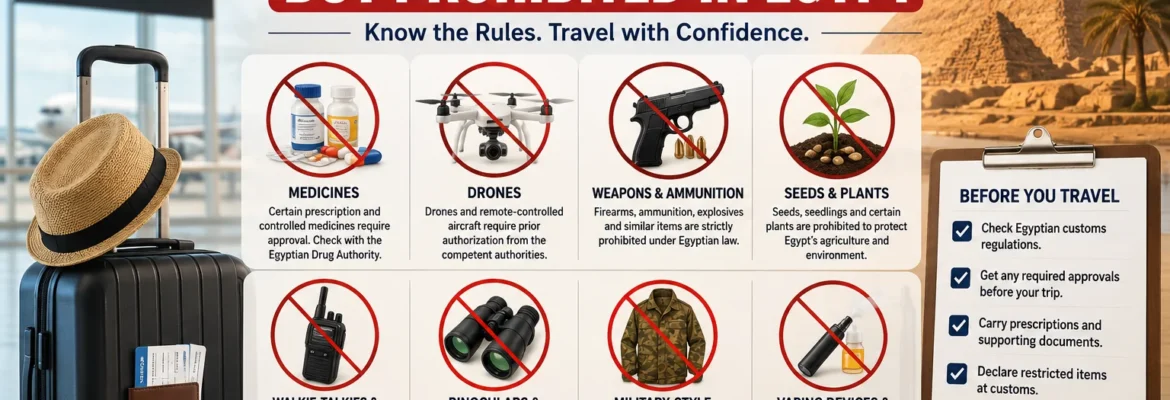
Some of the most important categories include medicines, drones, weapons, seeds, communication equipment, specialized optical devices, and military-style clothing.
Understanding these rules before your trip can help you avoid customs delays, confiscation, fines, or other potential legal consequences.
Important: Not every item discussed below is absolutely prohibited in every circumstance. Egyptian customs distinguishes between prohibited goods and restricted goods. Some restricted goods may be allowed after obtaining the required approval or fulfilling specific conditions.
Things Allowed Abroad but Prohibited in Egypt: What Travelers Should Know
Travelers should remember that Things Allowed Abroad but Prohibited in Egypt may be subject to completely different customs and regulatory requirements when entering the country.
The fact that an item is legal in the country where you purchased it does not automatically mean that you can legally bring it into Egypt.
The Egyptian Customs Authority defines prohibited goods as goods that are not permitted to be imported or exported, while restricted goods are subject to specific conditions or approvals before they can enter or leave Egypt.
This distinction is particularly important for tourists, foreign residents, Egyptians returning from abroad, and anyone traveling with medicines, electronic equipment, agricultural products, or other regulated items.
1. Medicines That Are Legal Abroad
One of the most important examples of Things Allowed Abroad but Prohibited in Egypt involves medicines.
A medicine may be legally prescribed and commonly available in another country but still be subject to special controls when brought into Egypt.
This is especially important for medicines containing controlled or internationally regulated substances.
The Egyptian Drug Authority has advised travelers to review the laws and regulations applicable to medicines before traveling. For people who regularly use medication, the Authority recommends carrying a recent and certified medical prescription that clearly identifies the medicine and the patient’s medical condition and limiting the quantity to personal use during the trip.
What should you do before traveling with medication?
If you are traveling to Egypt with prescription medication:
- Check the active ingredients of your medicine.
- Determine whether the medicine contains a controlled substance.
- Carry the medicine in its original packaging.
- Keep a recent medical prescription with you.
- Carry only a reasonable quantity for personal use.
- Check whether prior approval is required.
- Do not assume that a medicine being legal in your home country means it is automatically unrestricted in Egypt.
If you are unsure about the legal status of a particular medicine, it is better to obtain professional advice before traveling.
External Source: Egyptian Drug Authority – Travelers and Controlled Medications
2. Drones and Remote-Controlled Aircraft
Drones are another important example of Things Allowed Abroad but Prohibited in Egypt, depending on the circumstances and the applicable approvals.
In many countries, drones are widely available for photography, tourism, recreation, and professional use.
However, travelers should not assume that because a drone can legally be purchased and used abroad, it can automatically be brought into Egypt.
The Egyptian Customs Authority lists radio-controlled aircraft among goods that require review by the relevant regulatory authorities, including the competent authorities such as the Ministry of Defense.
Before bringing a drone to Egypt
Before placing a drone in your luggage:
- Identify the exact model and technical specifications.
- Check the applicable Egyptian requirements.
- Determine whether prior authorization is required.
- Obtain the necessary approval before traveling.
- Keep all relevant documents available.
Trying to resolve the issue only after arriving at the airport can lead to delays or the temporary retention of the equipment.
3. Weapons, Ammunition and Other Prohibited Items
Weapons and ammunition are among the most serious categories travelers need to consider.
The Egyptian Customs Authority identifies weapons, ammunition, explosives, narcotics and certain other goods as prohibited goods.
An item that can legally be purchased or possessed in another country may therefore have a completely different legal status in Egypt.
Travelers should be particularly careful with:
- Firearms
- Ammunition
- Explosives
- Military equipment
- Certain weapons
- Other items that may legally be classified as weapons
Do not assume that a legal purchase abroad gives you the right to import the item into Egypt.
If you are uncertain about an item, obtain legal advice before traveling.
4. Seeds, Plants and Agricultural Products
Seeds and agricultural materials are another category that travelers frequently overlook.
A packet of seeds purchased legally from a store abroad may still be subject to Egyptian agricultural quarantine and customs regulations.
Egyptian airport guidance states that bringing seeds and agricultural seedlings into Egypt is prohibited, while the Egyptian Customs Authority also identifies agricultural seeds and pesticides as goods requiring regulatory review.
These restrictions exist to help protect Egyptian agriculture from pests, diseases, and other biological risks.
Travelers should therefore be cautious with:
- Agricultural seeds
- Seedlings
- Plants
- Agricultural pesticides
- Other agricultural materials
Even a small quantity intended for personal use should not automatically be assumed to be exempt.
5. Walkie-Talkies and Specialized Communication Equipment
Communication equipment can create another unexpected customs issue.
Certain walkie-talkies and specialized radio communication devices may be subject to regulatory restrictions in Egypt.
This is another example of Things Allowed Abroad but Prohibited in Egypt where the legal treatment may depend on the type and specifications of the equipment.
Travelers should distinguish between ordinary personal electronics, such as mobile phones and laptops, and specialized communication equipment.
The Egyptian Customs Authority identifies certain electronic and communication-related equipment as items that may require review by the relevant authorities.
If you are traveling with professional radio equipment, specialized communication devices, or unusual electronic equipment, verify the requirements before departure.
6. Binoculars and Specialized Optical Equipment
Binoculars may appear to be ordinary travel equipment, especially for tourists, photographers, and outdoor enthusiasts.
However, certain optical equipment may be subject to regulatory review in Egypt.
The Egyptian Customs Authority lists binoculars among goods that may require approval or review by the competent authorities.
This is particularly important when the equipment is specialized, high-powered, professional, or intended for purposes beyond ordinary tourism.
If you are carrying specialized optical equipment, check the applicable requirements before traveling.
7. Military-Style or Camouflage Clothing
Camouflage clothing may be ordinary outdoor clothing or fashion in some countries.
However, military or camouflage clothing can be subject to special requirements in Egypt.
The Egyptian Customs Authority specifically lists military and camouflage clothing among goods requiring review by the competent authorities, such as the Ministry of Defense.
Travelers should therefore be cautious when carrying:
- Military uniforms
- Camouflage uniforms
- Military-style clothing
- Specialized tactical clothing
- Similar equipment that could be confused with official military items
The fact that the clothing was legally purchased abroad does not automatically determine its legal status in Egypt.
Other Items You Should Check Before Traveling to Egypt
The seven categories above are not an exhaustive list of Things Allowed Abroad but Prohibited in Egypt.
Egyptian customs regulations cover many different types of goods, and some items may be prohibited while others may require approval from the relevant authority.
The Egyptian Customs Authority lists examples of restricted goods that can include:
- Medicines
- Drones and radio-controlled aircraft
- Binoculars
- Electronic cigarettes
- Color printers
- Cosmetics beyond personal-use quantities
- Veterinary medicines
- Military or camouflage clothing
- Agricultural seeds and pesticides
- Certain animal products
- Other regulated equipment and materials.
The legal treatment can depend on the item’s type, quantity, purpose and applicable regulatory requirements.
This is why travelers should not rely on a simple list of “legal” and “illegal” items.
Why Something Legal Abroad May Be Illegal or Restricted in Egypt
One of the most important principles for international travelers is that Egyptian law applies when goods enter Egyptian territory.
Every country establishes its own rules concerning:
- Public safety
- Weapons
- Medicines
- Agricultural quarantine
- Communications equipment
- Customs
- Environmental protection
- National security
- Commercial imports
For example, a drone may be legally purchased in another country, but that does not necessarily mean it can be brought into Egypt without authorization.
Likewise, a prescription medicine may be commonly used abroad but may be subject to special controls in Egypt.
Therefore, Things Allowed Abroad but Prohibited in Egypt should always be checked before your trip rather than after you arrive.
Personal Luggage Does Not Always Mean Automatic Exemption
Another important point is that travelers should not assume that an item is automatically permitted simply because it is inside personal luggage.
Egyptian customs regulations define personal luggage according to the nature and quantity of items normally needed by a traveler during a trip. The goods should be appropriate for personal or family use and should not have a commercial character.
This means that the quantity and purpose of an item can matter.
For example, several identical new devices may attract greater scrutiny than a single device intended for genuine personal use.
Customs authorities may also require certain goods to be presented to the relevant regulatory authority.
What Can Happen If You Bring a Restricted Item Without Approval?
The consequences depend on the specific item and the applicable Egyptian law.
Potential consequences can include:
- Customs inspection
- Temporary retention of the item
- Confiscation
- Requirement to obtain regulatory approval
- Payment of applicable customs duties or taxes
- Administrative procedures
- More serious legal consequences for prohibited goods
The seriousness of the situation depends on the nature of the item and the applicable legal provisions.
For this reason, travelers should never attempt to conceal a restricted or prohibited item.
If you are unsure whether something can legally enter Egypt, check the applicable regulations before traveling.
How to Check an Item Before Traveling to Egypt
If you are not sure whether an item is permitted, follow these steps.
Step 1: Identify the Item
Find the exact name, model, manufacturer and technical specifications.
Step 2: Determine Its Purpose
Consider whether the item is intended for:
- Personal use
- Medical treatment
- Photography
- Communication
- Professional use
- Commercial use
- Another specialized purpose
Step 3: Check Egyptian Customs Regulations
Review the official information published by the Egyptian Customs Authority.
External Link: Egyptian Customs Authority – Travel and Tourism Regulations
Step 4: Check the Competent Authority
Some goods are not regulated by customs alone.
Depending on the item, you may need to check with another Egyptian authority, such as the Egyptian Drug Authority or another competent regulatory body.
Step 5: Obtain Any Required Approval
If an item requires prior authorization, obtain that approval before traveling.
Step 6: Keep Your Documents
Keep prescriptions, invoices, permits, certificates and other supporting documents with you.
Frequently Asked Questions About Things Allowed Abroad but Prohibited in Egypt
Can I bring medicine that is legal in my country into Egypt?
Not necessarily. Some medicines may be subject to special controls in Egypt, especially medicines containing controlled substances.
The Egyptian Drug Authority recommends that travelers check the applicable regulations and carry appropriate medical documentation when traveling with regulated medicines.
Can I bring a drone to Egypt?
Drones and radio-controlled aircraft can be subject to regulatory requirements and approval from the competent authorities. Travelers should check the applicable Egyptian regulations before bringing a drone into the country.
Can I bring seeds into Egypt?
Seeds and agricultural seedlings are subject to strict controls. Travelers should not assume that seeds purchased abroad for personal use can automatically be brought into Egypt.
Can I bring a walkie-talkie to Egypt?
Certain walkie-talkies and specialized radio communication equipment may be subject to restrictions or regulatory approval. The exact requirements can depend on the equipment and its specifications.
Are restricted items completely prohibited?
No. There is an important legal distinction between prohibited goods and restricted goods.
Prohibited goods generally cannot be imported or exported, while restricted goods may be allowed after satisfying the required conditions or obtaining approval from the competent authority.
What should I do if I am unsure about an item?
Do not rely on assumptions or on the laws of another country.
Check the official Egyptian regulations or consult a qualified Egyptian lawyer before traveling.
Legal Advice Before Traveling to Egypt
Understanding Things Allowed Abroad but Prohibited in Egypt before your journey can help you avoid unnecessary customs problems.
If you are traveling with medication, drones, specialized electronic equipment, agricultural products, optical equipment, military-style clothing, or any other unusual item, it is better to check the legal requirements before your flight.
At Experts Attorneys At Law, our legal team provides legal consultations in Egypt and assists clients with various areas of Egyptian law.
For matters involving property and ownership, you can learn more about our Real Estate Law services.
If your matter involves civil legal rights or disputes, you can also visit our Civil Law services.
For immigration and residency-related legal matters, see our Migration Law services.
If you need assistance regarding a will or inheritance, you can review our Last Will & Testament Law services.
You can also Contact Experts Attorneys At Law to discuss your legal matter.
Final Advice for Travelers
The most important lesson is simple:
An item being legal in another country does not automatically make it legal to bring into Egypt.
Before traveling, check the applicable Egyptian customs and regulatory requirements for anything unusual or potentially restricted.
Medicines, drones, weapons, seeds, communication equipment, specialized optical devices, and military-style clothing are examples of items that may require special attention.
Knowing about Things Allowed Abroad but Prohibited in Egypt before your journey is one of the easiest ways to reduce the risk of customs delays, confiscation, or other legal problems.
When in doubt, seek professional legal advice before your flight rather than after arriving at the airport.
Legal Disclaimer: This article is provided for general informational purposes only and does not constitute legal advice. Egyptian customs and regulatory requirements may change, and the legal treatment of an item depends on its nature, quantity, purpose and the applicable laws and regulations at the time of travel.
Leave a Replay