Posted Sep 2026
- 0 comment
- 0
What Law Applies on an International Flight? 7 Critical Rules Explained
What law applies on an international flight if a crime or serious incident occurs while the aircraft is flying over another country?
International flights can create complicated legal questions because one aircraft may have connections with several countries at the same time.
An aircraft may depart from Egypt, fly through another country’s airspace, be registered in a different State, operate under another legal structure, and finally land in another country.
So, what law applies on an international flight?
The answer is not necessarily the law of the country where the aircraft departed. It is also not automatically the exclusive law of the country below the aircraft.
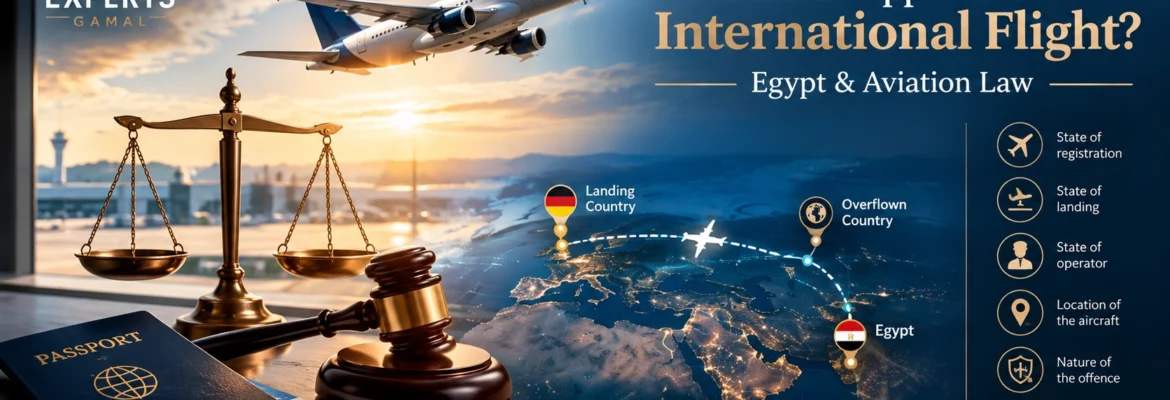
International aviation jurisdiction may depend on several factors, including the State of registration, State of landing, State of the operator, location of the aircraft, nature of the offence, applicable international treaties, and relevant domestic law.
For flights departing from Egypt, including flights from Cairo International Airport and Hurghada International Airport, these questions can become particularly important when an incident occurs outside Egyptian airspace.
The principal international framework includes the Chicago Convention of 1944, the Tokyo Convention of 1963, and the Montréal Protocol of 2014.
What Law Applies on an International Flight? The Short Answer
There is no single rule that determines jurisdiction in every international flight incident.
Depending on the circumstances, more than one State may have jurisdiction over an offence committed on board an aircraft.
A proper legal analysis may require examining:
- The aircraft’s State of registration;
- The State where the aircraft landed;
- The State of the operator, where the applicable conditions are satisfied;
- The airspace in which the aircraft was located;
- The nationality of the persons involved, where relevant;
- The nature and seriousness of the alleged offence;
- The international treaties applicable between the States concerned; and
- The domestic criminal laws that may apply.
The most important practical point is that the country of departure does not automatically determine exclusive criminal jurisdiction.
1. Why Is Aircraft Jurisdiction Different From Ordinary Criminal Jurisdiction?
In an ordinary criminal case, one of the first questions is usually:
Where did the offence happen?
International aviation makes this question more complicated.
A single aircraft may:
- Depart from Egypt;
- Fly through the airspace of another country;
- Be registered in a third country;
- Be operated under a different international structure; and
- Land in a fourth country.
As a result, one incident may have legal connections with several jurisdictions.
This is why international aviation law developed specific rules concerning offences and certain other acts committed on board aircraft.
Internal Link Opportunity
You can link the phrase Egyptian criminal law to your relevant criminal-law article on the website.
Anchor Text: Egyptian criminal law2. Chicago Convention and Sovereignty Over Airspace
The Convention on International Civil Aviation of 1944, commonly known as the Chicago Convention, provides a fundamental framework for international civil aviation.
Article 1 establishes the principle that each State has complete and exclusive sovereignty over the airspace above its territory.
This principle becomes relevant when an aircraft departing from Egypt enters another country’s airspace.
However, airspace sovereignty and criminal jurisdiction are not necessarily the same legal concept.
Official Source
For the official international framework, see:
ICAO — Chicago Convention and relevant agreements
Airspace Sovereignty vs. Criminal Jurisdiction
This distinction is extremely important.
The fact that an aircraft is physically located over a particular State does not automatically mean that State has exclusive criminal jurisdiction over every act committed on board.
The Tokyo Convention and its amended framework establish specific jurisdictional rules concerning offences and certain acts committed on aircraft.
Therefore, when determining what law applies on an international flight, lawyers should distinguish between:
Airspace sovereignty
and
criminal jurisdiction over conduct occurring on board the aircraft.
3. Tokyo Convention and Offences Committed on Board Aircraft
The Convention on Offences and Certain Other Acts Committed on Board Aircraft, adopted in Tokyo in 1963, is commonly known as the Tokyo Convention.
The Convention applies to:
- Offences against penal law; and
- Certain acts that may jeopardize the safety of the aircraft, persons or property on board, or good order and discipline.
The Tokyo Convention therefore provides an important international framework for incidents occurring during flights.
Official Source
ICAO — Current List of Parties to Air Law Treaties
State of Registration: A Central Jurisdictional Connection
Under the Tokyo Convention framework, the State of registration is a central jurisdictional connection.
ICAO materials explain that the State of registration is competent to exercise jurisdiction over offences and acts committed on board aircraft registered in that State.
Example
Suppose an aircraft:
- Departs from Hurghada, Egypt;
- Is registered in Egypt;
- Flies over another country; and
- A passenger commits an offence on board.
Egypt may have jurisdiction based on its status as the State of registration, subject to the applicable legal framework.
The important distinction is that this jurisdictional connection arises from aircraft registration, rather than simply from the airport of departure.
4. Does Leaving From Egypt Automatically Mean Egyptian Law Applies?
No.
The country of departure and the State of registration may be different.
Scenario A: Egyptian Departure and Egyptian Registration
An aircraft departs from Egypt and is registered in Egypt.
In this situation, Egypt has an important jurisdictional connection as the State of registration.
Scenario B: Egyptian Departure and Foreign Registration
An aircraft departs from Egypt but is registered in another country.
The fact that the aircraft departed from Egypt does not automatically make Egyptian criminal law the only potentially applicable law.
Other jurisdictional connections must be examined.
This is why the departure airport should be treated as one relevant fact, rather than automatically determining jurisdiction.
Internal Link
Use your relevant Egypt travel/legal article here.
Anchor Text: legal rules for international travellers in Egypt5. What Happens When an Aircraft Flies Over Another Country?
When an international aircraft enters another State’s airspace, that State exercises sovereignty over its airspace under the Chicago Convention.
However, the question what law applies on an international flight cannot necessarily be answered simply by identifying the country underneath the aircraft.
The specialized international rules concerning offences committed on board must also be considered.
The Role of the Overflown State
The aircraft’s location is an important factual element.
A lawyer should establish:
- The aircraft’s position at the time of the incident;
- Which country’s airspace it occupied;
- The approximate time of the incident;
- The flight route; and
- Whether any special aviation-security or criminal-law provisions apply.
The overflown State may have legal interests arising from territorial sovereignty and domestic law, but the precise jurisdictional consequences depend on the circumstances.
Why the Country Below the Aircraft Does Not Automatically Have Exclusive Jurisdiction
An aircraft may simultaneously have connections with several States.
For example:
Registered in Egypt → operated by an international airline → flying over Country B → landing in Germany
This is why aircraft jurisdiction cannot always be determined solely by looking at the country underneath the aircraft.
6. Montréal Protocol 2014 and Expanded Jurisdiction
The international framework was significantly developed by the Montréal Protocol of 2014, which amended the Tokyo Convention.
The Protocol entered into force on 1 January 2020.
The amended framework added important jurisdictional bases involving:
- The State of landing; and
- The State of the operator, in specified circumstances.
This development is particularly relevant to modern international aviation and aircraft leasing arrangements.
Official Sources
United Nations Treaty Collection — Montréal Protocol 2014
State of Landing
The State of landing is an important jurisdictional concept under the amended framework.
A State may exercise jurisdiction as the State of landing when the aircraft on which the offence or act was committed lands in its territory with the alleged offender still on board, subject to the applicable treaty conditions.
Example
Imagine:
- The aircraft departs from Hurghada, Egypt;
- An incident occurs during the flight;
- The aircraft continues to Germany;
- The aircraft lands in Germany;
- The alleged offender remains on board.
Germany may have jurisdiction as the State of landing, provided the applicable legal conditions are satisfied.
State of the Operator
The Montréal Protocol also recognizes the State of the operator in specified circumstances.
This can become particularly relevant where an aircraft is leased without crew and the aircraft’s registration differs from the State connected with the operator.
Under the amended framework, jurisdiction as the State of operator can arise where the relevant conditions concerning the lessee’s principal place of business or permanent residence are satisfied.
This demonstrates why aircraft registration alone may not always provide the complete answer.
7. Can More Than One Country Have Jurisdiction?
Yes.
An international flight can create jurisdictional connections with several States.
State of Registration
The State where the aircraft is registered may have jurisdiction under the Tokyo Convention framework.
State of Landing
The State where the aircraft lands may have jurisdiction where the Montréal Protocol conditions are satisfied.
State of Operator
The State of the operator may have jurisdiction in the circumstances covered by the amended framework.
Other Relevant States
Depending on the facts, other States may have legal interests or jurisdictional bases under their domestic law or other applicable international instruments.
Therefore, determining what law applies on an international flight may require a multi-jurisdictional analysis.
Is an Aircraft Considered the Territory of Its Registration State?
A common misconception is:
“An aircraft registered in Egypt is Egyptian territory wherever it flies.”
This is not the most accurate way to describe the legal position.
Aircraft registration creates an important legal and jurisdictional connection with the State of registration.
However:
Aircraft registration ≠ national territory
and
airspace sovereignty ≠ exclusive criminal jurisdiction over every incident.
For legal analysis, it is therefore more accurate to discuss the jurisdiction of the State of registration rather than simply describing an aircraft as the territory of that State.
Does the Nature of the Offence Affect Jurisdiction?
Yes.
Not every incident on an aircraft should be treated identically.
Possible incidents include:
- Verbal disturbances;
- Threatening behaviour;
- Physical assault;
- Serious bodily injury;
- Property damage;
- Drug-related offences;
- Possession of prohibited items;
- Unlawful interference with an aircraft;
- Hijacking; and
- Other aviation-security offences.
Some serious aviation offences are also addressed by additional international instruments.
Therefore, identifying exactly what happened is an essential first step.
Internal Link Opportunity
If your website has an article about prohibited items or airport restrictions, link:
Anchor Text: prohibited items when travelling to Egyptto that article.
What Law Applies on an International Flight From Egypt? A Practical Example
Consider a passenger boarding a flight in Hurghada, Egypt.
The aircraft departs from Hurghada International Airport and later flies over another country.
During the flight, the passenger seriously assaults another passenger.
The aircraft subsequently lands in Germany with the alleged offender still on board.
How should the jurisdictional analysis be approached?
Step 1: Identify the Aircraft Registration
First, determine where the aircraft is registered.
If it is registered in Egypt, Egypt has an important jurisdictional connection as the State of registration.
If it is registered elsewhere, the analysis changes.
Step 2: Identify the State of Landing
Determine where the aircraft actually landed.
If the aircraft landed in Germany with the alleged offender still on board, Germany may have jurisdiction as the State of landing where the applicable treaty requirements are satisfied.
Step 3: Identify the State of the Operator
The lawyer should establish:
- Who operates the aircraft;
- Whether the aircraft is leased;
- Whether it is leased with or without crew; and
- Which State is connected to the operator under the applicable legal framework.
Step 4: Establish the Aircraft’s Location
The precise location of the aircraft at the time of the incident should be established through available evidence, such as:
- Flight records;
- Aircraft tracking information;
- Flight route data;
- Crew reports; and
- The approximate time of the incident.
Step 5: Identify the Offence
The precise conduct must be assessed under the relevant domestic and international framework.
An assault, property offence, prohibited-item offence, or aviation-security offence may raise different legal questions.
Step 6: Examine Domestic Criminal Law
International conventions establish jurisdictional frameworks, but the actual offence, criminal procedure and penalties generally depend on the domestic law of the State exercising jurisdiction.
This is why what law applies on an international flight cannot be answered by looking at one international treaty alone.
International Treaties vs. Domestic Criminal Law
There are two separate questions.
Which State Has Jurisdiction?
International aviation treaties such as the Tokyo Convention and Montréal Protocol establish important jurisdictional rules.
Which Criminal Law and Penalties Apply?
Once a State exercises jurisdiction, its relevant domestic law may determine:
- The elements of the offence;
- Investigation procedures;
- Evidence requirements;
- Criminal proceedings; and
- Applicable penalties.
International aviation treaties should therefore not be understood as creating one worldwide criminal code for aircraft.
What If the Aircraft Is Registered in Egypt?
Where an aircraft is registered in Egypt, the State of registration provides an important jurisdictional connection under the Tokyo Convention framework.
However, the analysis should not stop there.
A lawyer should also examine:
- Where the incident occurred;
- Where the aircraft landed;
- Whether another State has jurisdiction;
- Who operated the aircraft;
- Whether the aircraft was leased;
- The nationality of the persons involved, where relevant;
- The nature of the offence; and
- The applicable domestic and international laws.
What If the Aircraft Only Departed From Egypt?
Departure from Egypt alone does not necessarily establish exclusive Egyptian criminal jurisdiction.
For example:
- The aircraft departs from Cairo;
- It is registered in another country;
- It is operated under an international leasing structure;
- It flies through several States; and
- It lands in Europe.
The fact that the flight started in Egypt is only one factual connection.
The aircraft’s registration, operator, flight route, State of landing and nature of the incident must also be examined.
7 Key Factors to Check in an International Flight Case
When asking what law applies on an international flight, these seven factors provide a useful starting point.
1. State of Registration
Where is the aircraft registered?
2. State of Landing
Where did the aircraft land, and was the alleged offender still on board?
3. State of Operator
Which State is connected to the operator under the applicable legal framework?
4. Aircraft Location
Where was the aircraft when the incident occurred?
5. Nature of the Offence
What exactly happened?
6. International Treaties
Which international conventions and protocols apply?
7. Domestic Criminal Law
What do the relevant national laws provide?
This seven-factor approach provides a practical starting point, but the precise answer depends on the facts and applicable law.
Frequently Asked Questions About International Flight Law
What law applies on an international flight?
The answer depends on several factors, including aircraft registration, State of landing, State of operator, aircraft location, nature of the offence and applicable international and domestic law.
Does Egyptian law apply if a flight leaves Egypt?
Not automatically.
Egypt may have an important jurisdictional connection if the aircraft is registered in Egypt, but other States may also have jurisdiction depending on the circumstances.
What if the aircraft is flying over another country?
The overflown State has sovereignty over the airspace above its territory under the Chicago Convention.
However, airspace sovereignty should not automatically be treated as exclusive criminal jurisdiction over every act committed on board.
Does the country where the aircraft lands have jurisdiction?
Potentially yes.
Under the Montréal Protocol framework, the State of landing may exercise jurisdiction when the relevant treaty conditions are satisfied, including circumstances where the aircraft lands with the alleged offender still on board.
Does aircraft registration matter?
Yes.
The State of registration is a central jurisdictional connection under the Tokyo Convention framework.
Can two or more countries have jurisdiction?
Yes.
An incident may create jurisdictional connections with the State of registration, State of landing, State of operator and potentially other States depending on the circumstances.
Is an aircraft the territory of its registration State?
It is more accurate to discuss aircraft registration and jurisdiction rather than simply treating an aircraft as the territory of its registration State.
Does the Montréal Protocol replace the Tokyo Convention?
No.
The Montréal Protocol of 2014 amends the Tokyo Convention and expands its jurisdictional framework. It entered into force on 1 January 2020.
Official International Legal Sources
For further research, the following official sources are particularly useful.
Chicago Convention
ICAO — Chicago Convention and Relevant Agreements
Tokyo Convention
ICAO — Current List of Parties to Air Law Treaties
Montréal Protocol 2014
United Nations Treaty Collection
UN Treaty Collection — Montréal Protocol 2014
These are official external sources, so they should satisfy Rank Math’s outbound-link requirement while giving readers authoritative material for further research.
Conclusion: What Law Applies on an International Flight?
So, what law applies on an international flight?
The answer cannot be determined simply by asking where the aircraft took off.
When an aircraft departs from Egypt and an incident occurs during an international flight, the legal analysis may involve several jurisdictions.
The Tokyo Convention of 1963 provides an important framework concerning the State of registration.
The Montréal Protocol of 2014 expanded that framework by adding jurisdictional bases involving the State of landing and, in specified circumstances, the State of the operator.
At the same time, the Chicago Convention establishes the fundamental principle of State sovereignty over national airspace.
Therefore, a proper analysis should consider:
Aircraft registration + State of landing + State of operator + aircraft location + nature of the offence + international treaties + domestic criminal law.
The key practical lesson is:
The country of departure does not automatically determine the applicable law.
For an actual case, the precise jurisdiction should be determined after reviewing the aircraft’s registration, flight route, place of landing, operator structure, persons involved, nature of the alleged offence, applicable international treaties and domestic laws.
Legal Disclaimer
This article is provided for general informational purposes only and does not constitute legal advice.
International aviation jurisdiction can depend on the specific facts of an incident, aircraft registration, State of landing, State of the operator, location of the aircraft, nature of the alleged offence, applicable international conventions and the domestic laws of the States concerned.
For a specific legal matter, professional legal advice should be obtained after reviewing the relevant facts and documents.
Legal Assistance in Egypt
If you are involved in a legal matter concerning an international flight, aviation-related incident, criminal allegation, immigration matter or another legal issue in Egypt, professional legal advice should be obtained based on the specific circumstances of the case.
Experts Attorneys At Law
Hurghada, Red Sea, Egypt
Email: info@hurghada-lawyer.com
Phone: +20 127 728 8880
Leave a Replay